







Interactive map
Solar eclipse of 2 August 2027 in the UK
Press play to watch the Moon's shadow. Tap your city to see what the Sun will look like.
10:00UK time (BST)
Our own calculation (PyEphem ephemeris) · Borders: Natural Earth
Even in Cornwall
Even at 47%, the Sun burns.
Everywhere in the UK, more than half of the Sun stays uncovered. That part is still direct sunlight: even a short look without protection can damage your retina for good.
This is the Sun at the peak of the eclipse, seen through certified glasses. The part still visible is the part that burns.
What many people think.
Myth‘In London less than half the Sun is covered, so I don't need glasses.’
RealityYou do. As long as any part of the Sun is visible, looking at it without a filter can burn your retina.
Myth‘It's cloudy, so it's safe to look.’
RealityNo. Cloud doesn't make it safe to look at the Sun, and eye damage can happen without any pain.
Myth‘A pair of very dark sunglasses is enough.’
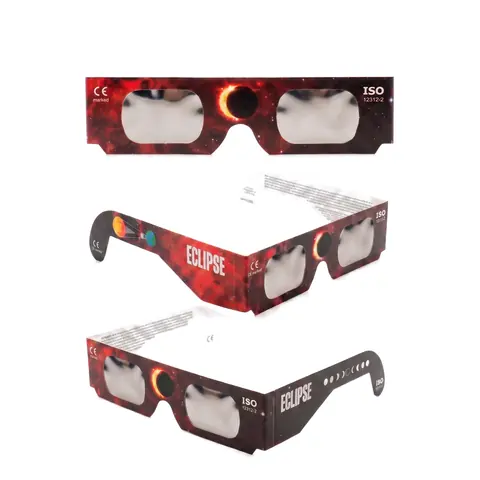
RealityNo. Only filters that meet ISO 12312-2 protect your eyes.
Myth‘A quick look without glasses won't hurt.’
RealityIt can. Even a short look at the Sun without protection can damage the retina permanently.
American Academy of Ophthalmology: looking at the Sun without protection, even briefly, can damage the retina for good and even cause blindness (solar retinopathy). See the source
NASA: during a partial eclipse it is never safe to look at the Sun without protection. Eclipse glasses must be worn the whole time. See the source
UK Health Security Agency: eclipse glasses should meet ISO 12312-2:2015. Sunglasses are not safe, however dark, and cloud cover does not make it safe to look at the Sun. See the source
In the UK, glasses from start to finish.
The eclipse is partial across the whole UK (up to 47% in Cornwall, 42% in London and 27% in Edinburgh): the Moon never covers the Sun completely. There is no safe moment to look at it without glasses.